Quick answer: In Florida, you can ask the court for a “restraining order” (injunction for protection) by filing a sworn petition with the Clerk of Court, getting a same-day judicial review for a temporary order, and then appearing at a final hearing—usually within about 15 days. The more specific your petition and evidence (texts, photos, witnesses), the stronger your case.
Want quick specifics? Jump to FAQs.
PAGE CONTENTS
Florida uses the term injunctions for protection, but most people know them as “restraining orders.” They are the same thing. Florida law just uses the word injunctions for some reason.
This page explains how to file, what qualifies, what evidence matters, and what to expect at your hearing.
If you’re deciding where to start, our main overview is here: Restraining Orders & Injunctions.
Need help right now? If you’re seeking protection, we can help you prepare a clear petition and organize your evidence.
If you need to get text messages or photos or videos, we can help.
Here is a blog on How to Prepare for Your Injunction Hearing — but feel free to call us FOR FREE with any questions or concerns you may have.
A restraining order (injunction) is a civil court order that can limit contact, require someone to stay away from certain places, and set other safety-related terms. The details matter: the judge looks for specific facts, credible fear, and (depending on the type) proof of qualifying conduct under Florida law.
For Florida’s statutory framework, you can review:
Fla. Stat. § 741.30
(domestic violence injunctions) and
Fla. Stat. § 784.046
(repeat, dating, and sexual violence injunctions).
If you want focused pages for common scenarios, see:
Domestic violence injunctions and
Stalking injunctions.
Generally, a petitioner is someone who has been the victim of qualifying violence, stalking/harassment, or has reasonable cause to believe harm is imminent. Many people file without a police report or criminal case—your sworn statement and supporting details can be enough to get the court’s attention.
You file with the Clerk of Court in the county where you live, where the respondent lives, or where the incident happened. In Orange County, the Clerk’s injunction resources are here:
Orange County Restraining Orders (Injunctions).
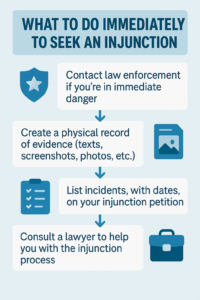
Tip: Judges tend to respond best to petitions that are specific (dates, locations, exact words, screenshots) and organized (timeline + exhibits).
After filing, a judge reviews the petition—often the same day. If the judge believes there is immediate danger or legal grounds, the court may issue a temporary injunction (ex parte). If not, the court may deny the temporary order and still set a hearing, depending on the situation.
The respondent must be formally served. This is typically handled by law enforcement. Service matters because the court usually cannot enter a final order without proper notice.
Final hearings are commonly scheduled quickly (often within about 15 days of a temporary order). This is where evidence and testimony become critical.
Evidence that often helps:
Many petitioners feel anxious about a hearing—especially in domestic or stalking situations. Depending on the facts and court expectations, a lawyer can often appear and advocate for you, present exhibits, and help reduce the risk of procedural mistakes. If this is a major concern, we can talk through options and what the court typically expects in your county.
Florida injunction hearings move fast. Even strong cases can be weakened by unclear petitions, missing exhibits, or avoidable hearing mistakes. An attorney can help you prepare your filing, organize evidence, and present a clear theory of the case at the hearing.
A final injunction can last for a defined period or be entered without an end date, depending on the case and the judge’s findings. Violations can lead to arrest and additional legal consequences. If you’re a respondent, it’s important to understand that even accidental or “small” contact can become a new legal problem.
Local note (Orange County): The Clerk has a helpful overview of where/how to file, FAQs, and what to expect:
Restraining Order FAQs (Orange County).
Useful evidence often includes text messages, emails, social media messages, photos/video, call logs, witness testimony, and any documentation that shows threats, violence, stalking, or escalation. The best petitions are specific (dates, quotes, locations) and supported by organized exhibits.
A judge may grant a temporary order the same day you file (depending on the petition). A final hearing is often set quickly—commonly within about two weeks—though schedules vary by county and service status.
Yes. The respondent can appear, present evidence, cross-examine witnesses, and request dismissal. That’s one reason preparation matters: hearings are short and decisions can turn on credibility and details.
A lawyer is not required to file. But legal help can be valuable—especially in higher-conflict cases, where the other side has counsel, or where the requested terms could impact children, firearms, housing, or employment.
You can typically file in the county where you live, where the respondent lives, or where the incident occurred. If you’re in Orange County, start here:
Orange County filing information.
Bring a photo ID, any screenshots/photos/video you want the judge to consider, a short written timeline, and any witness info. If you are seeking a temporary order, have your most urgent facts and exhibits easy to identify.
A denial of a temporary order does not always mean the case is “over.” Depending on the facts, the court may still set a hearing, or you may be able to correct issues in the petition. Getting advice before refiling can help avoid repeat mistakes.
Related Fighter Law resources
Important: This page is general information, not legal advice. Every injunction case is fact-specific. If you are in immediate danger, call 911.
Fill out the form below for an free evaluation of your case.






 Call Now